Traditional Arabic Bathroom Design
Try Traditional Arabic Style on Your Bathroom →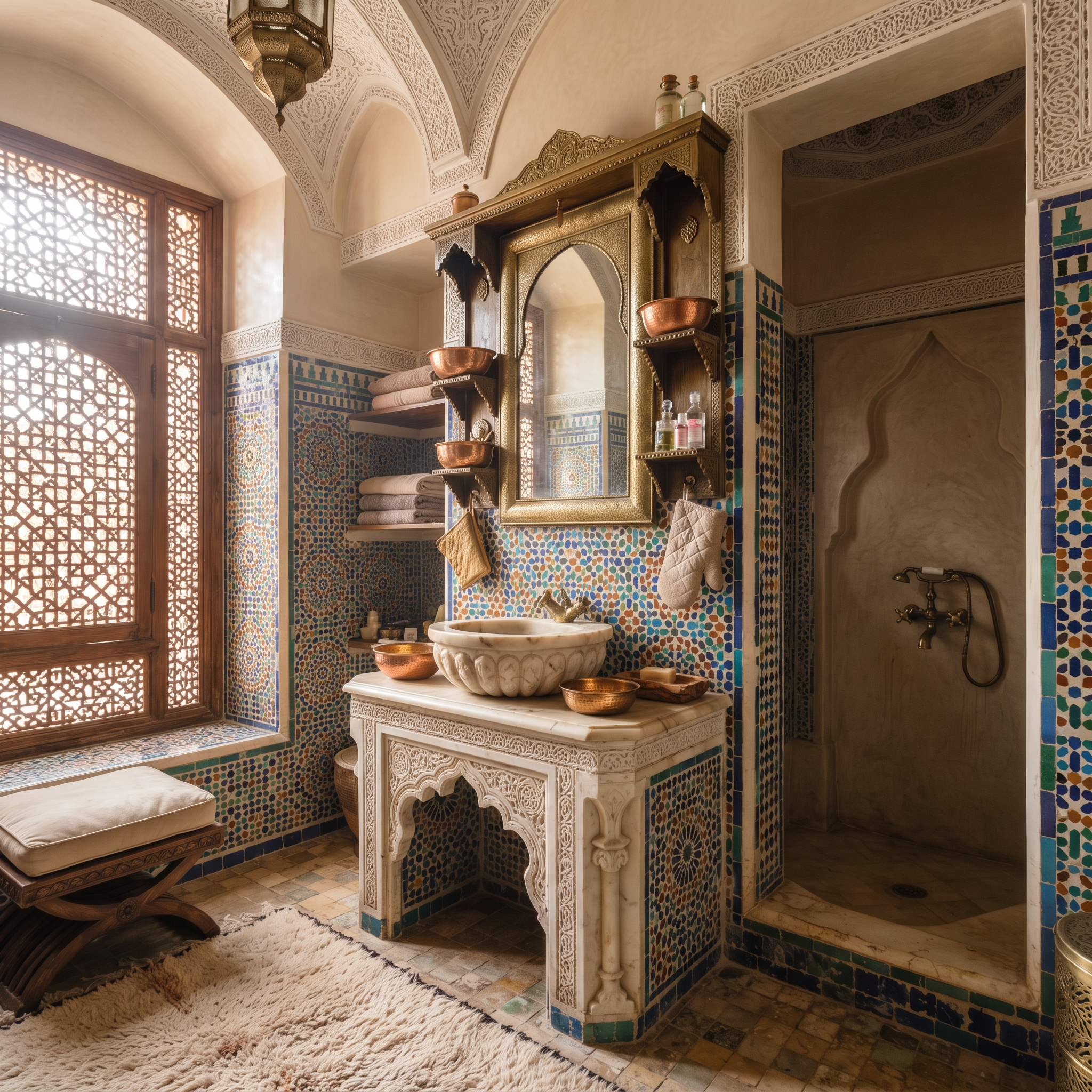
What is Traditional Arabic Bathroom Design?
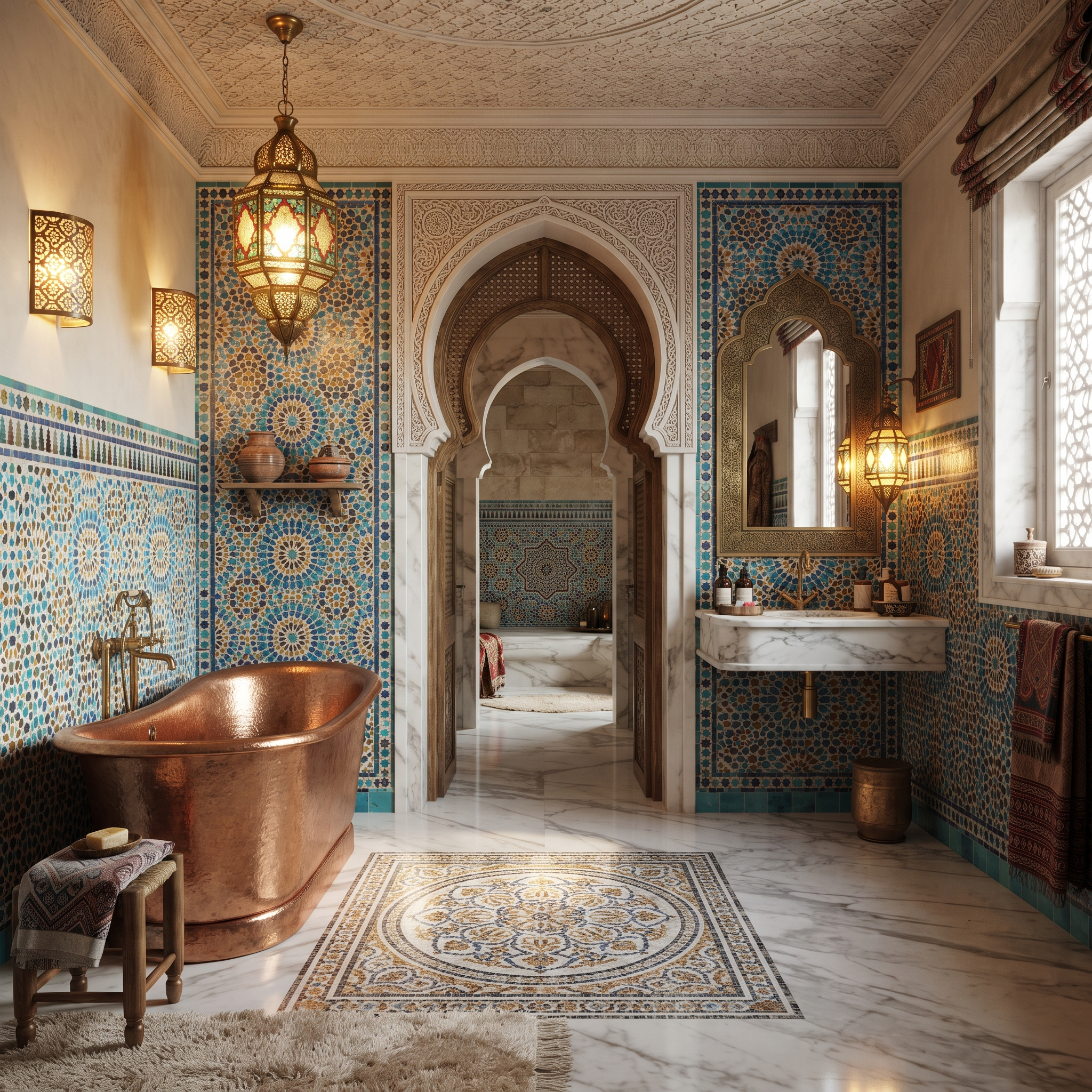
A traditional Arabic bathroom is built on pattern, craft, and the physics of water in a hot climate. The hammam — the communal bathhouse at the heart of Moorish and Ottoman culture — supplies the visual vocabulary: hand-cut zellige tile covering every surface, intricate geometric mosaics on the floor, and a central fountain or basin as the room's focus. A traditional Arabic bathroom layers these motifs without apology. Walls run floor to ceiling in jewel-toned tile — emerald, cobalt, saffron, turquoise — divided by carved plaster borders and arabesque bands. Star-shaped and eight-point patterns repeat across the floor. Fixtures are brass or bronze, often cast with traditional forms, and the basin might be a hammered copper or carved stone vessel. Arched alcoves hold soaps and folded towels; a pierced mashrabiya window throws geometric shadow across wet surfaces. Done well, a traditional Arabic bathroom is rich, immersive, and unapologetically ornate — closer to the interior of a riad than a Western bathroom. Every surface asks to be looked at.
Key Characteristics of a Traditional Arabic Bathroom
- Hand-cut zellige tile covering walls floor to ceiling in emerald, cobalt, saffron, or turquoise
- Intricate geometric mosaic floor patterns built from eight-point stars, crossbands, and repeating arabesque bands
- Central fountain or hammered copper basin positioned as the focus of the entire room
- Carved plaster borders and stucco moulding frame tile panels in traditional stalactite muqarnas forms
- Cast brass or bronze fixtures with traditional forms including spouted taps and star-shaped drain covers
- Arched alcoves and niches cut into walls to hold soaps, candles, and folded towels
- Pierced mashrabiya windows and timber screens casting geometric shadow patterns across the wet tiled surfaces
Best Materials
Traditional Arabic Bathroom Ideas for Every Space
Small Bathroom
Single jewel-toned zellige feature wall, hammered copper vessel basin, brass wall-mounted tap, and a star-patterned mosaic floor in cobalt and white.
Master Bathroom
Central fountain-style basin, full zellige walls in emerald and turquoise, arched alcove shelving, brass fixtures, and a carved plaster border running ceiling to floor.
Powder Room
Hammered copper basin on a carved stone console, brass tap, cobalt mosaic floor, and a mashrabiya window casting patterned light across the walls.
How Much Does a Traditional Arabic Bathroom Remodel Cost?
Traditional Arabic bathrooms sit at the premium end because authentic materials and skilled labour dominate the budget. Hand-cut Moroccan zellige costs $25–$60 per square foot, and installation by a tile artist runs $20–$40 per square foot given the irregular handmade pieces. A hammered copper basin costs $400–$1,200. Cast brass fixtures run $300–$700 per tap. Custom carved plaster borders and stucco work add $1,500–$5,000. A made-to-order mashrabiya screen runs $2,000–$6,000. Geometric mosaic floors laid by a specialist cost $40–$80 per square foot. To trim the budget without losing the soul, focus the zellige on a feature wall and use jewel-toned porcelain elsewhere.
Frequently Asked Questions
What is the difference between zellige and ordinary ceramic tile?
Zellige is hand-chiseled from glazed terracotta in Morocco, so every piece varies slightly in size, colour, and surface. That irregularity is the point — it catches light like no machine-made tile can. Standard ceramic is uniform and flat. Zellige costs 3–5 times more and needs a specialist installer.
Can I use traditional Arabic patterns in a small bathroom?
Yes, but limit yourself to one or two surfaces. Pattern on every wall overwhelms a small room. Pick a feature wall or the floor, keep the rest calm, and let a single jewel tone lead. A mashrabiya screen or arched mirror can carry the style without tiling everything.
How do I clean and seal zellige tile?
Seal zellige after installation and re-seal every 12–24 months. Clean with a mild pH-neutral soap and a soft cloth — never acidic or abrasive cleaners, which etch the glaze. The slight unevenness traps grout haze, so have your installer clean thoroughly as they go.
Explore More Bathroom Design Styles
Ready to see traditional arabic style on your bathroom?
Upload Your Photo →