Transitional Bathroom Design
Try Transitional Style on Your Bathroom →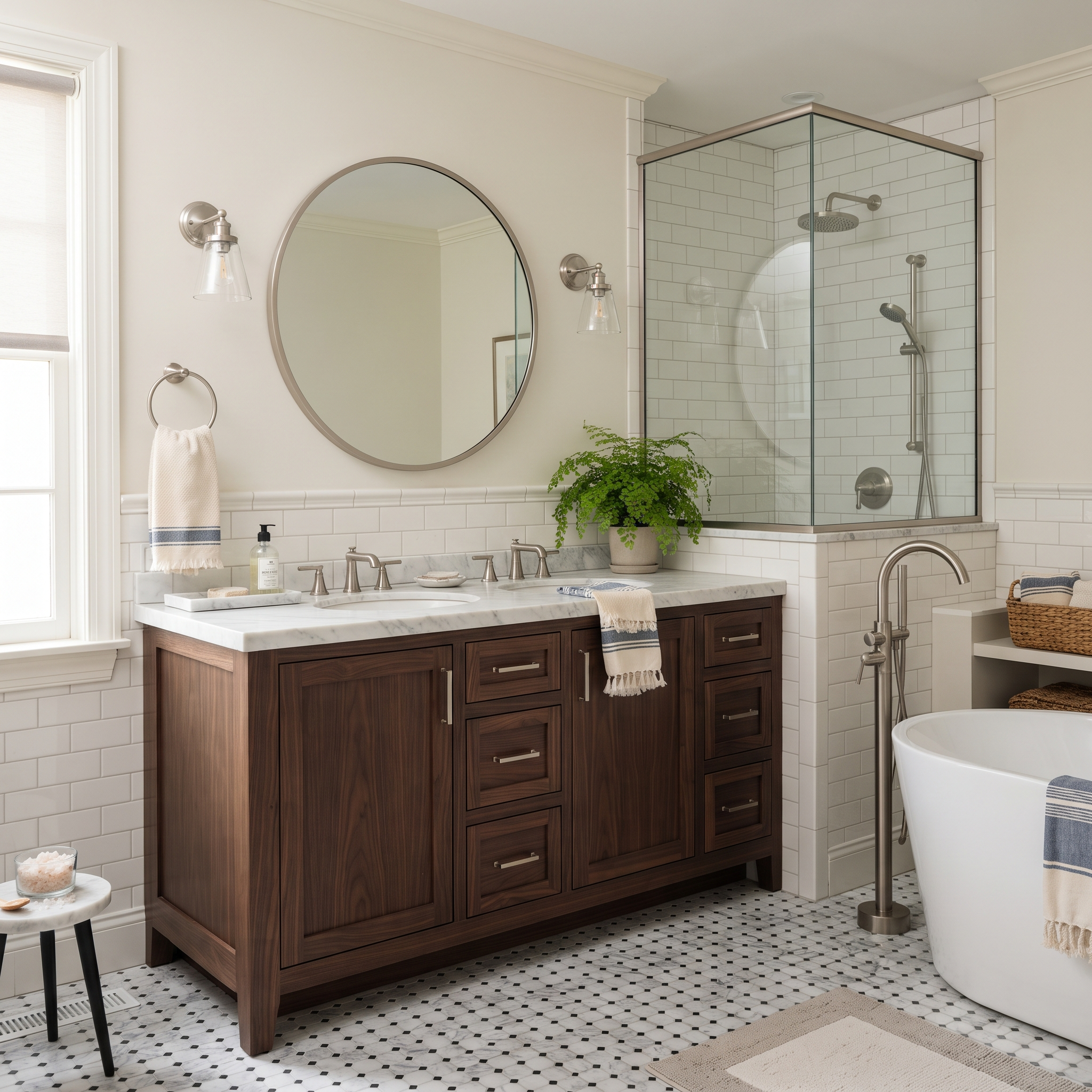
What is Transitional Bathroom Design?
Transitional bathroom design sits deliberately between traditional and contemporary, taking the best of both without committing fully to either. From traditional it borrows warmth and familiarity — shaker-style cabinetry, framed mirrors, and classic subway tile. From contemporary it takes cleaner lines, mixed materials, and updated fixture finishes. The result is a bathroom that feels current but not trendy, warm but not fussy. A transitional bathroom might feature a shaker vanity in a soft grey with brushed nickel cup pulls, a marble-look quartz countertop, a frameless shower with simple chrome hardware, and warm white walls. The palette stays neutral — greys, whites, warm taupes — without the stark minimalism of modern or the ornate detailing of traditional. Transitional is the most popular bathroom style for family homes because it adapts to any house age and any resale scenario.
Key Characteristics of a Transitional Bathroom
- Shaker-style cabinetry in soft neutral tones — grey, sage, navy, or warm white
- Marble-look quartz countertop — the luxury material without the maintenance
- Subway tile in the shower paired with frameless glass (not black-framed)
- Brushed nickel or aged bronze fixtures — warm but not flashy
- Framed mirrors with simple profiles — no ornate gilding, no frameless panels
- Warm white or soft grey walls — lighter than traditional, warmer than modern
- Mixed textures: smooth quartz + matte cabinetry + subtle tile pattern
Best Materials
Transitional Bathroom Ideas for Every Space
Small Bathroom
Single shaker vanity in sage green, round mirror with a thin metal frame, white subway tile shower, and warm grey hex floor tile.
Master Bathroom
Double shaker vanity in soft grey, quartz counters, framed rectangular mirrors, walk-in shower with niche, and a separate water closet.
Powder Room
Floating shaker console, vessel sink in white ceramic, brushed nickel tap, and a single sconce with a linen shade.
How Much Does a Transitional Bathroom Remodel Cost?
Transitional bathrooms land in the mid-range because they use widely available materials. Shaker vanities cost $800–$2,500 depending on size and finish. Quartz countertops ($300–$800 for a standard vanity) deliver the marble look without the etching or sealing. Brushed nickel fixtures are mid-priced — more than chrome, less than brass. Subway tile ($4–$12 per square foot) keeps shower costs reasonable. The biggest variable: cabinetry quality. Flat-pack shaker vanities start at $400; custom-built hardwood shaker runs $3,000+. The upgrade that matters most: soft-close drawers and quality hinges — they make a $800 vanity feel like a $2,000 one.
Frequently Asked Questions
What makes transitional different from modern or traditional?
Transitional borrows cabinetry and tile from traditional (shaker doors, subway tile) but simplifies the lines and updates the finishes (frameless glass instead of framed, brushed nickel instead of polished chrome). It is intentionally in-between — warmer than modern, cleaner than traditional. Think of it as traditional with a contemporary filter applied.
What is the best countertop for a transitional bathroom?
Quartz in a marble-look pattern (Calacatta or Carrara). It gives the luxury of natural marble without the etching, staining, or annual sealing. Budget $300–$800 for a standard single vanity, $600–$1,200 for a double. Avoid solid surface (Corian) — it reads as budget and does not fit the transitional aesthetic.
Does transitional work for resale?
Transitional is the single best style for resale value. It appeals to the widest buyer pool because it is neither too modern (which some find cold) nor too traditional (which some find dated). A grey shaker vanity, subway tile, and brushed nickel fixtures will look appropriate to 90% of potential buyers.
Explore More Bathroom Design Styles
Ready to see transitional style on your bathroom?
Upload Your Photo →